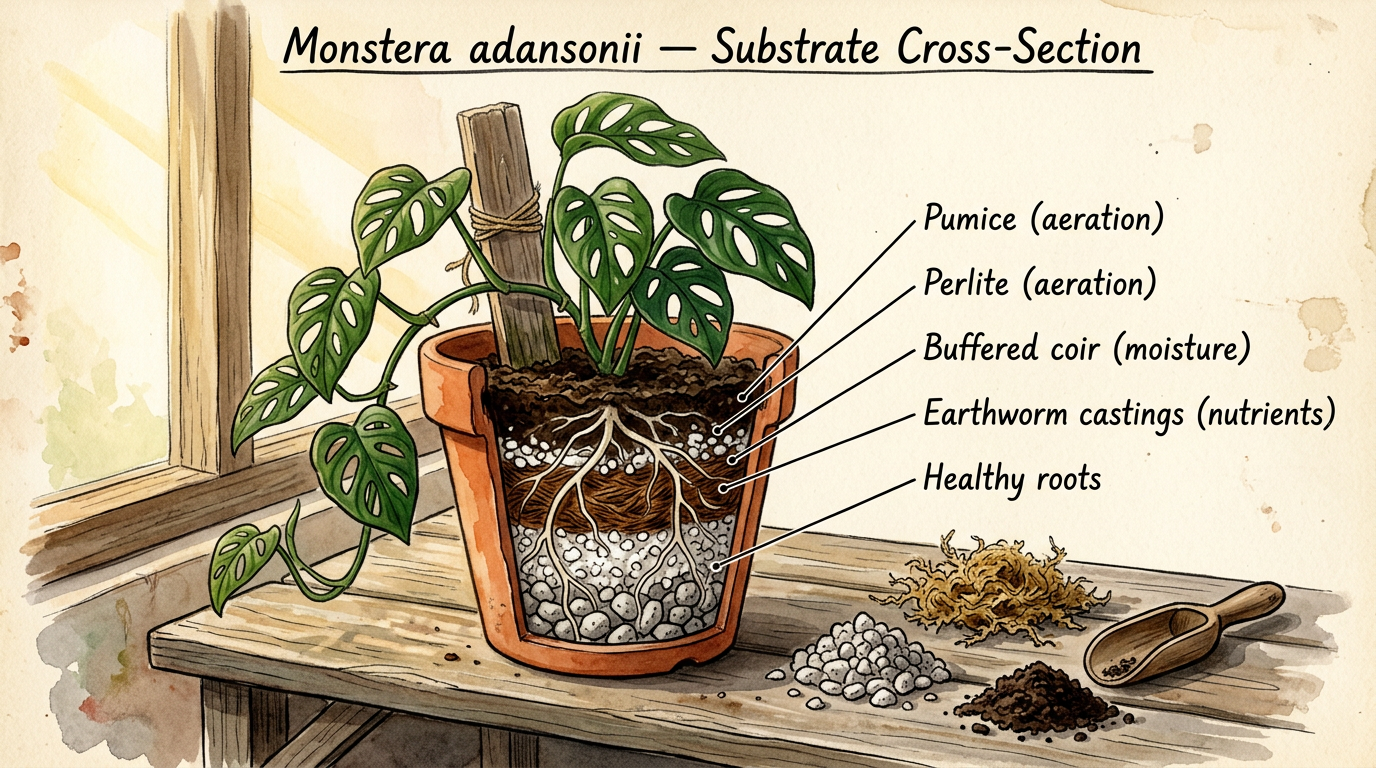
Before the recipes, the physics. Why a pot isn’t a patch of forest floor, where water actually lives in your mix, and the variables that decide whether a plant thrives or drowns.
Quick facts
Topic: Substrate physics + chemistry
Level: Foundational
Audience: Rare plant collectors
Prerequisites: None
Next in series: The Aroid Ingredient Glossary
Most of what goes wrong with a rare plant’s root system has nothing to do with your watering schedule. It’s the substrate. The plant is living inside a small ceramic cylinder you chose, filled with ingredients you picked, behaving according to physics that don’t work the way open ground works. Almost every “mysterious decline” we’ve investigated over the years has come back to one of three or four root-zone variables most growers never measure and rarely think about.
This is the first article in our substrate series because every recipe we publish assumes you understand what a substrate actually does. Once you have the root-zone model in your head, our recipes make sense — and more importantly, you can modify any recipe for your own conditions without guessing.
No math. No soil-science textbook. Just the handful of ideas that explain why some mixes work and some mixes kill plants.
A pot is not a piece of the forest floor
Walk into a tropical forest and dig up a Philodendron gloriosum. Look at where its roots actually live — a thin layer of decomposing leaf litter, loose and airy, draining straight onto the soil column beneath. The roots run horizontally through that top few inches. Below them is an effectively bottomless column of soil and rootable substrate, and whatever water falls as rain moves down through it under gravity, pulled continuously toward a water table that’s feet or tens of feet below.
Now put that same plant in a six-inch nursery pot on your shelf. You’ve taken a plant evolved for an open, gravity-dominated drainage column and sealed it inside a closed ceramic tube with a hole in the bottom. Everything about how water moves and where oxygen lives in that pot is different from what the plant expects.
The single most important thing to understand about container growing is that a pot creates a perched water table at its base, and that water table is maintained by surface tension, not drainage. Water doesn’t just “drain out” of a pot the way it drains through a forest floor. It drains until surface tension holds it against gravity — and then it stops. At that moment, the bottom portion of your substrate is fully saturated, regardless of how much drainage material you added. If there’s no air in that saturated layer, and if the roots are in it, the roots can’t breathe.
This is the central reality of container growing, and most substrate decisions flow from it. The substrates that work in containers are substrates that produce air even when they’re fully wet. That’s what all the chunky-aroid-mix talk is ultimately about.
Where water actually lives in a pot

When you water a plant and let the pot drain to equilibrium, the water you’ve just added distributes itself into three reservoirs inside the substrate. Each one behaves differently, and each one matters for a different reason.
Reservoir one: internal porosity. This is water held inside particles, in the microscopic pore structure of porous materials like pumice, coir pith, sphagnum, and earthworm castings. Most of this water is bound tightly enough that roots can only slowly access it, but it acts as a humidity reservoir — it evaporates slowly and keeps the substrate from drying to bone. Minerals like pumice have surprising internal porosity; a pumice chip can weigh more wet than dry by 30% or more.
Reservoir two: capillary water. This is the water clinging to the outside of particles and filling the narrow spaces between them, held there by surface tension. This is the water roots actually drink. It’s what separates a mix that feels “moist” from a mix that feels “damp.” Capillary water is the reason particle size matters so much — smaller particles mean tighter capillary spaces, mean more capillary water at equilibrium, mean wetter-behaving substrate.
Reservoir three: the air spaces. The gaps between particles that are large enough to let gravity win against surface tension. These are the spaces that don’t hold water and instead hold air. The fraction of the substrate occupied by these air spaces at container capacity — right after drainage — is called air-filled porosity, and it is the most important single variable in container growing.
A mix that’s 50% water and 10% air at container capacity will kill a tropical aroid slowly. A mix that’s 40% water and 20% air will grow the same plant spectacularly. The difference isn’t how much water the mix holds — it’s how much air.
The perched water table, and why drainage rocks are a myth

Almost everyone has heard the advice to “put some gravel or broken pottery in the bottom of your pot for drainage.” It is one of the most stubbornly persistent pieces of misinformation in houseplant culture, and it works exactly opposite to how most people think.
A perched water table forms at the interface between your substrate and anything with dramatically larger pore spaces beneath it. Water won’t cross that interface until the substrate above it is fully saturated, because surface tension holds it in the finer pore spaces of the substrate. So when you put drainage rocks at the bottom of a pot, you don’t lower your water table — you raise it. The saturated zone now sits on top of the rock layer, which is usually right where your roots are.
The right answer is the opposite: fill the pot with a uniform, well-aerated substrate all the way to the drainage hole. The perched water table still forms — physics is physics — but it forms at the very bottom of the pot, below most of your root mass. The substrate above it is in the aerated zone, which is where roots want to live.
If you want to reduce the depth of your saturated zone further, the lever you pull is particle size, not drainage layers. Larger particles mean larger pore spaces between them, which means a shallower perched water table. This is why chunky aroid mixes work: the coarse pumice, charcoal, and other structural elements don’t hold water at the bottom of the pot the way a fine peat-based mix does.
Air-filled porosity: the variable that decides everything
If you only remember one number from this entire article, make it this one: air-filled porosity at container capacity should be at least 15% for terrestrial tropicals, 20% for most aroids, and 25% or more for true epiphytes like Anthurium warocqueanum or climbing Philodendron species.
Air-filled porosity is the percentage of the total substrate volume occupied by air-filled pores immediately after you’ve watered and let the pot drain. You can measure it at home with a graduated container and a little patience — saturate a sample of substrate, let it drain for 15 minutes, then measure the water that drained out. That water came from the pores that will fill with air. Divide by the total substrate volume. That’s your number.
Most commercial “tropical” or “aroid” mixes come in at around 8 to 12% air-filled porosity when they’re fresh, and they drop further as the mix ages and compacts. This is why so many collectors arrive at the same conclusion independently: the bagged mix works until it doesn’t, and then it starts killing plants for reasons that feel mysterious.
Our recipes target 20% minimum for standard mixes, 25% for the Aroid Mineral Mix, and 30% or more for the ICU Mix. We hit those numbers by using high percentages of porous, structured minerals — pumice, perlite, charcoal, zeolite — and by specifying particle sizes that don’t collapse into tighter packing as the mix settles.
Cation exchange capacity, in plain English
A substrate’s job isn’t just to hold water and air. It also has to hold nutrients — or your fertilizer washes straight through and your plant starves in a well-aerated mix.
Cation exchange capacity (CEC) is the measure of how many positively charged nutrient ions a substrate can hold on its surfaces for the roots to pluck off as needed. Calcium, magnesium, potassium, ammonium — all the positively-charged nutrient ions — are held against leaching by this mechanism.

Different substrate ingredients have wildly different CEC:
- Perlite: essentially zero
- Pumice: very low
- Horticultural charcoal: low to moderate
- Coir: moderate
- Long-fiber sphagnum: moderate to high
- Earthworm castings: high
- Zeolite (clinoptilolite): extraordinarily high
This is why a mix built from pumice and perlite alone — even if it has perfect aeration — will slowly starve a plant. It can’t hold onto what you’re feeding it. The classic fix is to add organic matter, but organic matter also adds water retention and microbial food. Sometimes that’s what you want. Sometimes it isn’t.
The elegant move, and the one that changed our ICU Mix, is to add zeolite — a crystalline mineral with exchange capacity that rivals the best organic amendments, with none of the water retention or microbial load. A 10% zeolite inclusion roughly doubles the effective CEC of an otherwise-mineral-heavy mix. That’s a substantial shift in nutrient-holding without sacrificing a milliliter of air space.
pH, EC, and the tap water problem
Two more variables quietly decide whether the nutrients in your substrate are actually available to your plant.
pH determines chemical availability. Most tropical aroids want a substrate pH of 5.5 to 6.5. Above 7.0, iron and manganese become unavailable even if they’re present (and you start seeing chlorotic new leaves). Below 5.0, aluminum and manganese can become too available and start causing toxicity. Most of our recipes target 5.8 to 6.3.
EC (electrical conductivity) is the proxy measurement for total dissolved salts in the root zone. It tells you, roughly, how much “dissolved stuff” is in the water your roots are sitting in. Too low (under 0.3 mS/cm) and your plant isn’t getting enough nutrients. Too high (over 2.0 mS/cm for most tropicals) and you’re in fertilizer burn territory. The sweet spot for runoff EC on most houseplants is 0.8 to 1.4 mS/cm.
The tap water problem is this: your tap water has its own pH and EC before you ever add fertilizer. In much of California, for example, tap water runs pH 7.5 to 8.5 and carries a baseline EC of 0.5 to 0.8 mS/cm from dissolved calcium, magnesium, and sodium bicarbonates. That means every time you water, you’re pushing your substrate pH up and adding salts that accumulate over time. For collectors in hard-water regions, fluoride- and chloramine-sensitive plants (Marantaceae, especially) need either rainwater, RO water, or water run through a specific mineral filter.
A $20 pH and EC pen will change how you grow. It’s the one purchase that pays back fastest in plant survival.
Oxygen at the root zone — the variable nobody measures
Roots respire. They take in oxygen and release carbon dioxide, just like leaves do (in the opposite direction). When a root sits in saturated substrate with no air-filled pores, oxygen is consumed faster than it can diffuse in from the surface of the pot. Within hours, oxygen concentration at the root surface drops below the threshold where root cells can metabolize. Root cells start dying.
Dead root tissue is a welcome mat for anaerobic bacteria, saprophytic fungi, and everything else that wants to eat a dead root. Within 48 hours, what started as an oxygen-deprivation problem has become a pathogen problem. This is the pathway by which “a little overwatering” becomes “terminal root rot” faster than most growers realize.
Every decision in our substrate system — the high mineral fractions, the particle size specs, the rejection of peat — is ultimately about keeping oxygen available at the root zone even when the substrate is wet. Not because dry is good. Because roots drowning in saturated substrate are the #1 cause of decline in indoor tropical collections, and no amount of fertilizer, humidity, or light can save a plant whose roots are suffocating.
A practical checklist — diagnose the substrate before you blame the plant
When a rare plant starts declining and the cause isn’t obvious, we walk through the substrate before anything else:
- Does the substrate feel wet below the top inch more than 48 hours after watering? That’s a drainage/aeration problem. Either the mix has collapsed, the pot is too large, or the ingredients were wrong from the start.
- Does the substrate smell sour, mushroomy, or swamp-like? Anaerobic zones are established. Repot into a fresher, more aerated mix immediately.
- Does the surface show white salt crust? EC has climbed. Flush the pot with several pot-volumes of plain water, let it drain fully, and reduce fertilizer frequency.
- Does the pot weight feel identical a week after watering? The substrate isn’t drying. Either your pot is too large for the root mass, humidity is too high, or the mix is too water-retentive.
- Have you measured pH and runoff EC? If not, do it. A pen costs less than one rare plant.
- How old is the substrate? Most bagged mixes collapse within 12 to 18 months. Ours do too, though closer to 18 to 24 with the chunkier recipes. If it’s been longer than that, repot.
Nine out of ten root-zone problems we investigate resolve at this list. The tenth is usually a pest or an environmental problem, but substrate comes first because it’s the variable most often wrong and most often invisible.
What comes next
You now have the model. Water lives in three places, air-filled porosity is the number that matters, CEC is how your substrate holds onto nutrients, pH and EC decide whether those nutrients are available, and oxygen at the root zone is the quiet variable that decides whether roots live or die.
The next article in this series — The Aroid Ingredient Glossary: Particle by Particle — works through every ingredient that commonly shows up in chunky tropical mixes, including the ones we don’t use, with honest notes on what each one actually does and where it’s worth the money. After that, Designing a Mix: The Logic Behind the Ratios takes the ingredients and walks through how we combine them. From there, we get into the recipes.
If you’ve been growing for a while and this is the first time any of this has been framed plainly — you’re not alone. Most substrate content online skips the physics entirely and jumps straight to recipes. The physics is what lets the recipes make sense.
Ready to go deeper?
Now that you have the root-zone model, meet the ingredients. Up next: The Aroid Ingredient Glossary — Particle by Particle, a full walk through every common substrate component, what it does, what to buy, and the ones we’ve concluded aren’t worth it.