
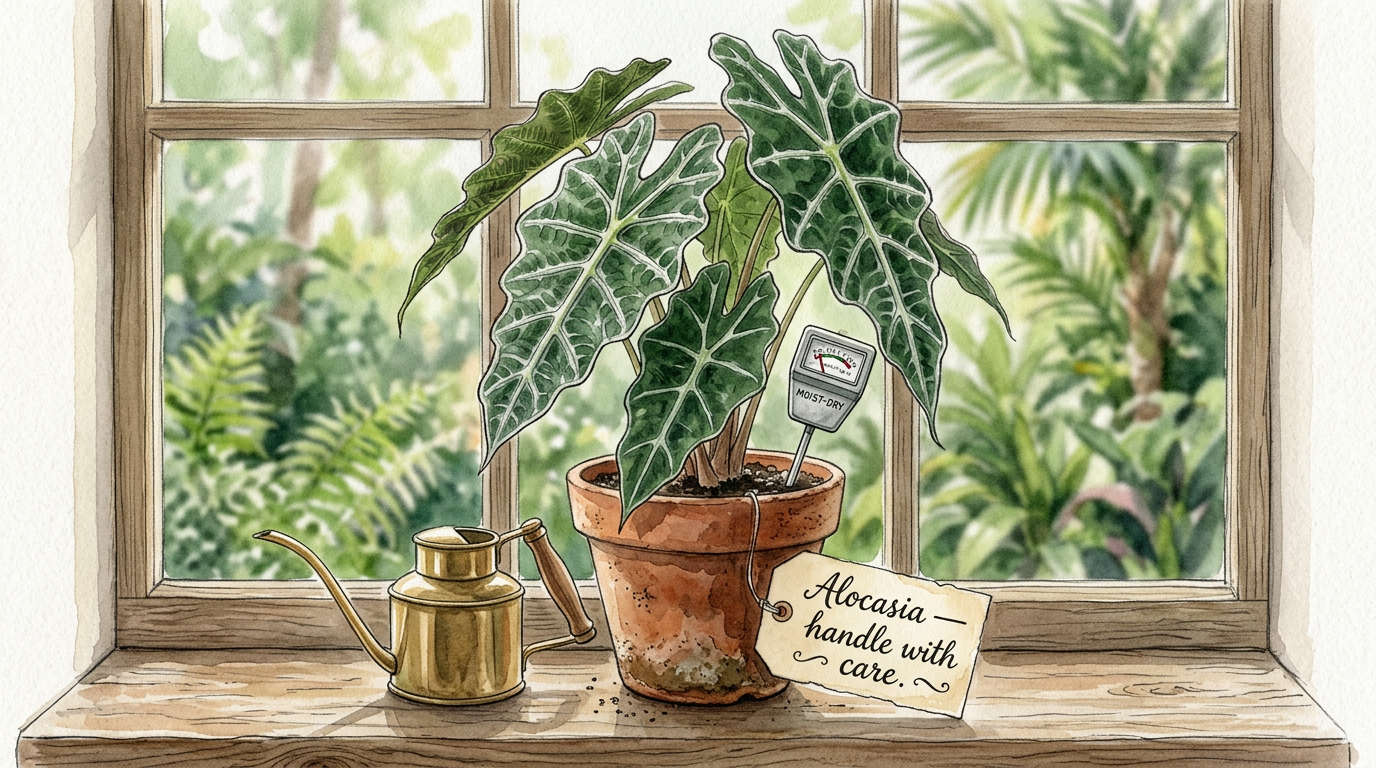
Alocasia is the genus that teaches you everything you thought you already knew about houseplant care is slightly wrong. They want light, but not that light. They want water, but not that much water. They want humidity, but they’ll also rot if you look at them too sympathetically on a Tuesday.
They are, in other words, magnificent — and magnificently opinionated. Here’s how to keep them happy.
What You’re Actually Growing
Alocasia is a genus of about 100 species in the family Araceae — the aroids. They’re native to the tropical and subtropical forests of Southeast Asia and eastern Australia, where they grow as understory plants on the forest floor, often near streams or in areas with consistently moist (but not waterlogged) soil.
Their defining feature is those extraordinary leaves. Alocasias hold their leaves upright and outward — the petioles connect to the leaf blade in a way that angles them toward the sky, which is why they’re sometimes called “upright elephant ears” (their cousins Colocasia, by contrast, let their leaves droop downward). It’s a structural adaptation for catching filtered light through a dense canopy overhead.
Most Alocasias grow from underground corms — starchy, bulb-like storage organs. This is important because it means the plant has a built-in survival mechanism: if conditions go sideways, an Alocasia can drop all its leaves, go dormant, and regrow from the corm when things improve. It’s not dead. It’s waiting.
Five Popular Varieties Worth Knowing
Alocasia × amazonica ‘Polly’ — The gateway Alocasia. Dark green, deeply lobed leaves with bright white veins and a compact growth habit. She’s dramatic, widely available, and will absolutely drop a leaf the moment you change anything about her environment. Don’t take it personally.
Alocasia zebrina — Named for the striking yellow-and-brown zebra-striped petioles that hold up its arrow-shaped green leaves. The leaves are relatively plain; the stems are the main event. Zebrina is one of the more forgiving species — a good second Alocasia after Polly has taught you humility.
Alocasia micholitziana ‘Frydek’ — Velvet-textured dark green leaves with white veins. Frydek has a softness that photographs don’t fully capture. It’s a mid-size species that does surprisingly well indoors once you nail the humidity. A quiet stunner.
Alocasia maharani (‘Grey Dragon’) — Thick, rigid, almost stone-like leaves with a silvery-grey surface texture that looks more mineral than botanical. Maharani stays compact and is less fussy about humidity than its relatives, making it a solid choice for drier indoor environments.
Alocasia baginda ‘Dragon Scale’ — The collector’s darling. Deeply textured leaves that look like hammered metal or, yes, dragon scales. The veins are deeply impressed, and the leaf surface has a matte, almost alien quality. It wants more humidity than most homes provide naturally, so a humidifier or terrarium setup earns its keep here.
Light: Bright but Never Direct
In their native habitat, Alocasias grow under the canopy — receiving filtered, dappled light that shifts throughout the day. Indoors, this translates to bright indirect light. An east-facing window is ideal: morning sun is gentle enough that it won’t scorch the leaves, and it provides consistent brightness through the morning hours.
In the Bay Area, west-facing windows can work but may deliver too much intense afternoon sun during summer. If you notice leaf edges browning or pale, washed-out patches developing on the upper leaves, you’re getting too much direct exposure. Pull the plant back a foot or two, or filter the light with a sheer curtain.
Low light is the real killer. Alocasias in dim corners will lose leaves faster than they produce them — a slow, demoralizing decline that’s easy to misdiagnose. If your Alocasia is steadily shrinking from five leaves to three to one, it’s not pests or overwatering. It’s probably light.
Water: The Goldilocks Problem
Alocasias want consistently moist soil — not wet, not dry, not “I forgot about it for two weeks and then panicked.” The sweet spot is a substrate that’s lightly damp to the touch at the top inch, with good moisture deeper in the pot.
Water when the top inch of substrate has dried. In summer, that might be every 4–5 days; in winter (especially in heated Bay Area homes where indoor humidity plummets), it might stretch to every 7–10 days. Let the plant’s environment dictate the schedule, not the calendar.
The danger zones: overwatering causes root rot faster in Alocasia than in almost any other common houseplant, because those corms are vulnerable to sustained moisture. Underwatering causes leaf drop and dormancy. The plant would rather go to sleep than die of thirst — which is admirable, but not what you want from a decorative houseplant.
Substrate: Chunky and Fast-Draining
This is where substrate science meets real-world Alocasia care. Standard potting soil is too dense — it holds too much water around the corm and roots, creating the exact conditions that cause rot.
A good Alocasia mix prioritizes air-filled porosity while retaining enough moisture that you’re not watering daily. A reliable starting formula: 40% orchid bark, 30% perlite or pumice, 20% coco coir, and 10% horticultural charcoal. This gives you drainage, aeration, some moisture retention, and a mild antimicrobial component from the charcoal.
For the thicker-leafed species like maharani and dragon scale, you can lean even chunkier — increase the bark and perlite ratio. Their thick leaves store more water, so they tolerate a faster-drying mix. For Polly and Frydek, keep the coir ratio slightly higher to maintain consistent moisture.
Humidity and Temperature
Alocasias want 60%+ humidity. Most Bay Area homes sit between 40–55% indoors, which is borderline. You have options: group your tropical plants together (collective transpiration raises local humidity), run a humidifier nearby, or place the pot on a pebble tray with water below the pot’s base.
Misting is the most recommended and least effective solution. It raises humidity for about four minutes and then evaporates. It also deposits water on the leaves, which can encourage fungal issues. Skip it.
Temperature-wise, Alocasias are happiest between 65–80°F. They have no tolerance for cold drafts — a window cracked open on a foggy San Francisco night can cause leaf damage. And below 55°F, many species will begin dropping leaves and entering dormancy whether you want them to or not.
When Things Go Sideways
Yellowing lower leaves: Usually the oldest leaf being reabsorbed to fuel new growth. One at a time is normal. Multiple at once suggests overwatering or insufficient light.
Brown, crispy leaf edges: Low humidity or inconsistent watering. Check both.
Spider mites: Alocasias are spider mite magnets, especially in dry indoor air. Check the undersides of leaves regularly — you’ll see fine webbing before you see the mites. A regular wipe-down with a damp cloth is the best preventive measure. If they’ve arrived, neem oil or insecticidal soap applied every 5–7 days for three rounds.
Complete leaf loss: Don’t throw it away. Check the corm — if it’s firm and not mushy, the plant is dormant, not dead. Reduce watering to barely moist, keep it warm, and wait. New growth often emerges within a few weeks to a couple of months.
Petruscio Farms — Guided by Science. Rooted in Care.
Explore more plant care guides · Browse the collections · Get in touch