
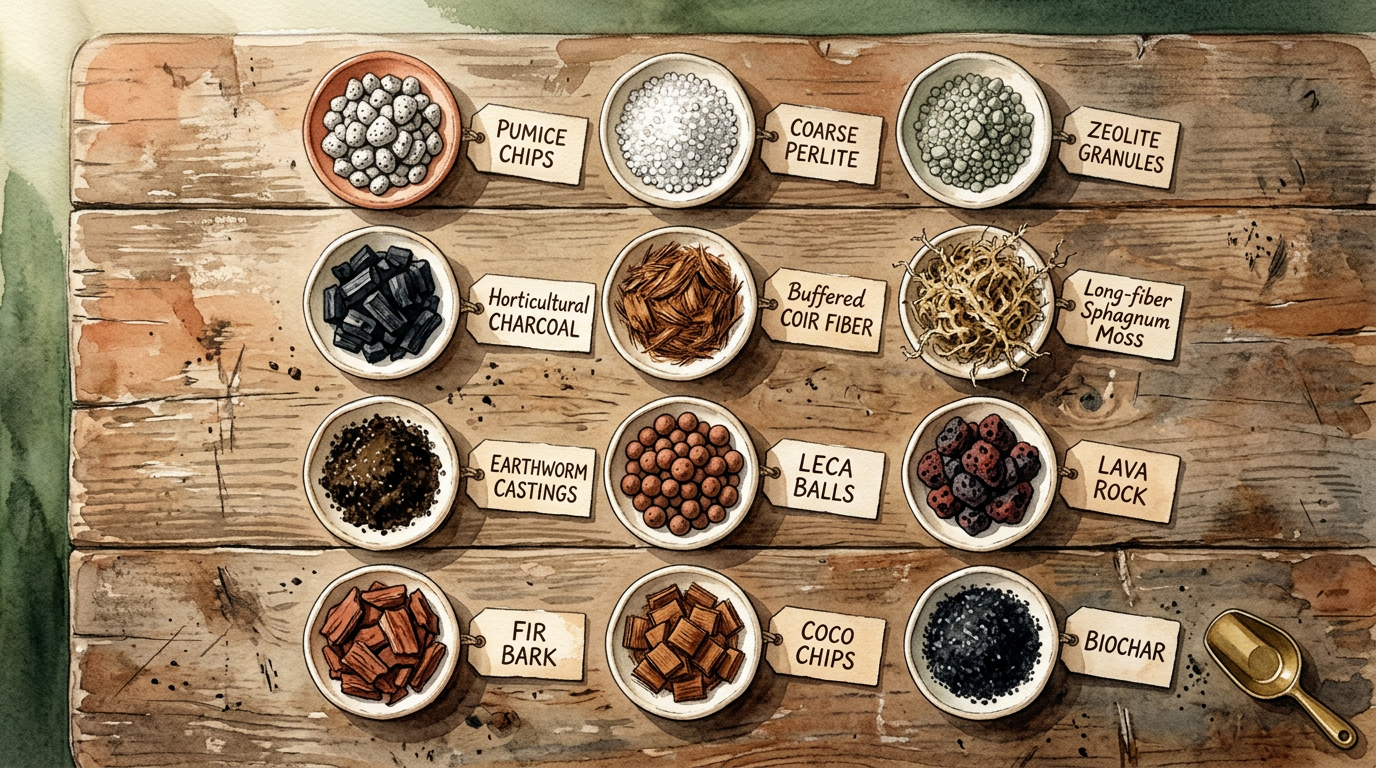
Every ingredient that shows up in a chunky tropical mix — what it is, what it actually does in the root zone, where it’s worth buying, and where we’ve concluded it isn’t. Including the ingredients we deliberately avoid.
Quick facts
Topic: Ingredient reference
Level: Foundational
Audience: Collectors designing or evaluating mixes
Prerequisites: Article 1 (How Substrate Actually Works)
Next in series: Designing a Mix — The Logic Behind the Ratios
A recipe is just percentages on paper. What’s going on inside the pot is a dozen different particles each behaving differently from each other. If you don’t know what each one is doing, mechanically and chemically, then every substrate adjustment is a guess.
This is the article we link back to in every recipe discussion. It covers every ingredient that commonly shows up in chunky aroid and tropical mixes, whether we use it or not. For each: what it is, what it does in the root zone, what grades to buy, how it plays with the others, and our verdict on whether it earns its spot.
A note on honesty: we don’t use bark, coco chips, or peat. Several of us have allergies that make those ingredients non-starters, and over years of iteration we’ve concluded they’re substitutable without performance loss. But they’re in this article too, because a collector reading our recipes deserves to understand why we made those trades — and when the ingredients we avoid might still be the right choice for someone else.

How to read each entry
Every ingredient below follows the same four-line structure:
- What it is — origin, processing, what you’re actually buying.
- What it does — mechanical (water, air, structure) and chemical (pH, CEC, nutrient load).
- What to buy — grades, sizing, sourcing notes.
- Our verdict — use regularly, use selectively, or avoid, with reasoning.
Prices are US retail ranges in early 2026 dollars, for the grower buying 1 to 2 cubic feet at a time. Bulk commercial sourcing changes the math considerably.
Structural minerals we use
Pumice
What it is. Porous volcanic glass, mined and screened to size. It forms when rapidly cooling magma traps gas bubbles, which is why it’s full of internal pores. Major US sources are the Pacific Northwest (Oregon and Idaho) and Arizona; imported pumice comes from Italy, Greece, and Turkey.
What it does. Pumice is the backbone mineral of our system. Moderate water retention (~30% by weight when saturated), excellent aeration when sized correctly, near-neutral pH (~6.8 to 7.2), and a surprising amount of internal surface area that supports beneficial microbial colonization. Low CEC but not zero. The internal pore walls do hold some nutrient ions. Doesn’t break down on any schedule you’ll be repotting on.
What to buy. Two grades cover our entire system: 1/4 inch for standard and ICU mixes, 1/2 inch (coarse) for epiphytic aroid mixes and moss pole cores. \”Dry Stall\” or \”Dragon Substrate\” are popular brand labels; bonsai suppliers sell screened grades at a premium. Avoid anything labeled just \”pumice\” without a particle-size spec — cheap bags are often mostly scoria or crushed cinder (acceptable but denser and less porous).
Our verdict. Use regularly. If we had to reduce our ingredient list to three items, pumice is #1.
Perlite
What it is. Volcanic glass (different chemistry from pumice) that’s been superheated to pop like popcorn, creating a very low-density white particle full of closed air pockets. Industrially produced, not mined directly.
What it does. Aeration and lightness, essentially nothing else. Very low water retention (~20% by weight, most of which evaporates quickly), effectively zero CEC, neutral pH. It’s structure filler — it creates air space and does not compete for water or nutrients. The tradeoff is it compresses under its own weight over time, breaks down mechanically as roots push through it, and floats to the surface with repeated watering.
What to buy. Coarse grade only — labeled as #3, \”chunky\”, \”horticultural coarse\”, or \”extra-coarse.\” Avoid fine perlite: it compacts, floats, and generates airway-irritating dust that’s genuinely unpleasant to work with if you have respiratory sensitivities. The dust concern is not minor; always wet perlite down before scooping if you’re sensitive.
Our verdict. Use regularly, but as a secondary structural mineral to pumice. Perlite alone makes a light, short-lived mix. Paired with pumice, it adds aeration without adding weight.
Zeolite (clinoptilolite)
What it is. A naturally occurring aluminosilicate mineral with a crystalline structure riddled with molecule-sized channels. Clinoptilolite is the horticulturally useful type — there are dozens of other zeolites, but most are industrial catalysts. Mined in Turkey, Slovakia, Arizona, and Oregon.
What it does. Zeolite is where the math changes. Its cation exchange capacity is around 2.0 meq/g — values drawn from published horticultural soil science literature and clinoptilolite supplier technical data; exact CEC varies by mineral source and measurement methodology — roughly 5 times higher than earthworm castings, 50 times higher than coir, and orders of magnitude higher than perlite. It preferentially holds ammonium, potassium, and calcium ions, releasing them to roots as they’re taken up. It’s also biologically inert, doesn’t break down, contributes zero microbial load, and has near-neutral pH.
In a mineral-heavy mix, a 10% zeolite inclusion roughly doubles the effective nutrient-holding capacity without adding a single milliliter of water retention or a gram of organic matter. That’s why our ICU Mix works where earlier versions didn’t. The plant regains the ability to absorb what you feed it, even in a substrate that’s 70% minerals.
What to buy. 1 to 3 mm for general use; 3 to 5 mm for coarse aroid mixes. Sold as \”horticultural zeolite,\” \”clinoptilolite,\” \”Ecosand,\” or sometimes as a pet supply (\”odor-absorbing rock\”). Check the mesh size — some pet-market bags are ground too fine to be useful.
Our verdict. Use regularly. The single highest-impact addition to our system in the last two years.
Horticultural charcoal
What it is. Wood charcoal that’s been kiln-fired to high temperatures to remove volatile compounds, then screened for horticultural use. Not the same thing as activated carbon (which is processed further with steam or acid), and definitely not the same thing as BBQ charcoal (which contains binders and accelerants you absolutely do not want in a pot).
What it does. Structural, porous, chemically inert, and mildly alkaline (pH 7.5 to 8.0). Moderate CEC — not as high as zeolite but better than pumice or perlite. Its real job in our system is as the bark-free structural element — the chunky particle that gives aerial roots of epiphytic aroids something to grip, the way orchid bark would. It also adsorbs some excess salts and organic compounds — a structural characteristic of porous charcoal, though horticultural charcoal is less effective per gram than activated charcoal — acting as a mild buffer against fertilizer spikes in our own testing across 100+ potted plantlets (2024–2025).
What to buy. Two grades: 1/8 inch for fine inclusion in standard and Goeppertia mixes; 1/4 to 1/2 inch chunks for the Aroid Mineral Mix. \”Horticultural charcoal\” from reputable brands (RePotme, Hoffman, Black Gold) is fine. Avoid anything described as \”activated\” for general substrate use — it’s over-processed and expensive.
Our verdict. Use regularly. The unsung hero of our aroid mixes.
Lava rock (scoria)
What it is. Volcanic rock — basalt that cooled with gas trapped inside, similar to pumice but denser and less porous. Red, black, or brown depending on iron content.
What it does. Structural mineral, denser than pumice, moderate internal porosity. Near-neutral pH, low CEC, doesn’t break down. Functionally very similar to pumice in the root zone but heavier per unit volume, which makes potted plants more stable on a shelf (useful for top-heavy epiphytes on moss poles).
What to buy. 1/4 to 3/8 inch chunks are ideal. Bonsai-grade lava rock is clean and screened; cheaper landscape lava rock often contains dust and sub-sized particles that need sifting before use.
Our verdict. Use selectively. A legitimate substitute for pumice or coarse charcoal when you want weight in the pot. We don’t feature it in our core recipes because pumice plus charcoal covers the same functional space with less added weight, but it’s a good option for outdoor aroid displays or heavy specimens.
LECA (lightweight expanded clay aggregate)
What it is. Clay pellets fired at high temperatures, which causes them to expand into porous balls. Also called hydroton or expanded clay. Originally manufactured for hydroponics.
What it does. Structural, very low density, moderate water retention via internal porosity, moderate CEC, neutral pH. Unique in this list: LECA is the foundation of semi-hydroponic systems where the entire pot is filled with LECA and nutrient solution is maintained in a reservoir at the bottom.
What to buy. 8 to 16 mm pellets from a major brand (Hydroton, Lecaton, Mother Earth Hydroclay). Rinse thoroughly before first use — LECA sheds significant dust.
Our verdict. Use selectively. We don’t use LECA in our soil-based recipes (the particle size is too large to integrate into a diverse mix), but semi-hydro is a legitimate adjacent system for some collectors. If you’re moving a plant fully to semi-hydro, that’s a different set of decisions than building a traditional mix — worth a dedicated article in its own right.
Biochar
What it is. Charcoal produced specifically as a soil amendment, usually from agricultural waste (rice hulls, coconut shells, hardwood) pyrolyzed in low oxygen. Newer to horticultural markets than traditional charcoal.
What it does. Similar in structure to horticultural charcoal but typically finer and more variable in quality. High internal surface area that supports microbial colonization, moderate CEC, slight alkalinity. In the right application, it’s a significant microbiome booster.
What to buy. Quality varies widely. Look for biochar specifically labeled for horticultural use, with a known feedstock (coconut-shell biochar is clean and consistent; hardwood biochar varies). Avoid anything sold as \”biochar soil conditioner\” at a garden center without specifications.
Our verdict. Use selectively. Promising ingredient; we’re still evaluating it in comparative trials against horticultural charcoal. For now, a good 1/8 inch horticultural charcoal is more predictable.
Water-retentive organics we use
Buffered coir
What it is. Coconut husk processed into fine pith or medium-length fiber. \”Buffered\” means the coir has been pre-treated (usually with calcium nitrate) to displace the potassium and sodium that would otherwise leach into the root zone and cause nutrient imbalances.
One thing to clear up first: coir is not coco chips. Coir is the fine fibrous and pith material from the inner husk. Coco chips are the chunky pieces of outer husk. They look different, behave differently, and have different allergen profiles.
What it does. Water retention, moderate CEC (~0.4 meq/g), slightly acidic (pH 5.8 to 6.5), slowly releases potassium and lignin-derived compounds as it breaks down. Provides the capillary backbone of our mixes — the material that holds water where roots can actually drink it.
Unbuffered coir is a major source of unexplained calcium and magnesium deficiencies in houseplant collections. The K and Na loaded into raw coir displace Ca and Mg at the root surface through competitive exchange, and by the time you notice the problem, your plant has been slowly starved of divalent cations for months. We don’t compromise on this.
What to buy. Calcium-buffered coir from a reputable supplier (Char Coir, Mother Earth Coco, Coco Bliss Plus) in medium pith for general use, fine pith for TC transition mixes. Test a new lot: mix a 1:1.5 ratio of coir to distilled water, let it sit 30 minutes, and measure the EC of the runoff. It should be under 0.5 mS/cm. If it’s higher, rinse and re-test or return the bag.
Our verdict. Use regularly. Non-negotiable that it’s buffered.
Long-fiber sphagnum
What it is. Whole, fibrous strands of Sphagnum moss, harvested and dried. Different from \”sphagnum peat moss,\” which is decomposed, compressed, and milled (we don’t use that). New Zealand long-fiber is the global quality benchmark; Chilean AAA is a legitimate, more affordable alternative.
What it does. Exceptional capillary action — water travels through sphagnum faster than through almost any other substrate material. Native pH around 4.0 (low) and practically antimicrobial: sphagnum’s low pH combined with its native phenolic compounds creates an environment that suppresses many common fungal pathogens. This is why sphagnum has been used in orchid propagation and even wound dressings for over a century. The exact biochemistry is complex and still an active research area, but the field effect — reduced fungal pressure in high-humidity propagation setups — is consistently reported across decades of grower use. High water retention by weight, but the fibrous structure maintains air channels even when saturated.
Critical for tissue culture acclimation, where its antimicrobial properties buy the plantlet the 2 to 3 weeks it needs to develop functional stomata without losing the battle to saprophytic fungi. Also valuable at 10 to 15% inclusion in Goeppertia mixes to even out moisture without going anaerobic.
What to buy. New Zealand long-fiber if you can get it and don’t mind the price (~$25 to $40/brick). Chilean AAA grade is our default at the greenhouse (~$15 to $25/brick). Avoid \”sphagnum moss\” sold in small craft-store bags for floral arranging — it’s usually low-grade and often not long-fiber.
Our verdict. Use regularly for specific applications: TC acclimation (Stage 1), Goeppertia mix, moss poles, and any situation requiring capillary water delivery.
Biological and nutrient inputs we use
Earthworm castings (vermicompost)
What it is. The excretion of red wiggler or European nightcrawler worms fed on pre-composted organic material. Essentially, finished compost that’s been through an earthworm digestive tract, which both accelerates breakdown and enriches the microbial community. Good vermicompost smells earthy and sweet; bad vermicompost smells sour or ammoniacal.
What it does. Provides the three things minerals can’t: slow-release nutrients (balanced NPK at low levels, plus micronutrients and plant growth hormones), beneficial microbiota (Trichoderma, Bacillus subtilis, various PGPR species), and humic substances that chelate micronutrients and buffer pH. Relatively high CEC for an organic input. pH typically 6.5 to 7.0.
Tradeoff: castings are organic matter, which means they’re food for anything that wants to eat organic matter. Including the pathogens we’re trying to avoid. This is why our ICU Mix uses only 10% castings — enough for the net microbial benefit, not enough to tip the balance toward a fungal bloom if things go slightly wet.
What to buy. Quality varies more than any other ingredient in this glossary. Look for a product that smells earthy and sweet, has consistent fine particle size (not chunky with visible wood fragments), and comes from a source willing to disclose their feedstock. Worm Gold Plus and Unco Industries Wiggle Worm are reliable; many local commercial worm farms produce excellent castings at better prices.
Sift before using. Fresh castings almost always contain worm cocoons, unprocessed plant debris, and occasionally small pebbles. A kitchen strainer handles it in minutes.
Our verdict. Use regularly, in quantities appropriate to the application (5 to 15% depending on mix). Replace the bag if it ever smells sour.
Ingredients we avoid
These are the ingredients that show up in most commercial chunky aroid mixes but aren’t in ours. For most of these, the reason is a real allergen, sourcing, or performance issue we’ve worked to substitute around. None of these are inherently bad ingredients — they just don’t fit our system.
Orchid bark (fir bark)
What it is. Graded chunks of Douglas fir or similar conifer bark, processed for horticultural use. The default structural element in most aroid and orchid mixes.
Why we avoid it. Three reasons. One, bark dust is a significant respiratory irritant for growers with allergies — a lived issue for several of us. Two, bark is a notorious reservoir for fungal spores (Trichoderma in various species, some pathogenic Fusarium strains) and microscopic contaminants that can compromise plants already under stress. Three, bark breaks down faster than inert minerals (typically 12 to 18 months), and its breakdown products acidify the mix in ways that can go unnoticed until the plant is struggling.
When it’s still the right choice. If you don’t have allergies, buy from a reputable bonsai or orchid supplier (not garden-center bagged bark), and repot on a disciplined schedule, bark is a completely legitimate aroid ingredient. It’s just not the only option, and replacing it with horticultural charcoal + coarse pumice has given us comparable aerial-root grip without the dust.
Coco chips (coco husk chunks)
What it is. The chunky pieces of coconut outer husk, sold separately from coir pith. Visually similar to orchid bark and increasingly marketed as a sustainable substitute.
Why we avoid it. Similar profile to bark — the chunks shed fiber dust that’s an allergen concern, and commercial coco chip lots are notoriously variable in EC and pH. Many lots arrive heavily salt-loaded and require extensive rinsing before use. The salt problem is the same as unbuffered coir, but chunky coco chips are harder to buffer effectively — most are sold raw.
When it’s still the right choice. For growers without allergy concerns who are willing to rinse and buffer each new lot, coco chips are a reasonable bark substitute. Just test EC on every bag.
Peat moss / sphagnum peat
What it is. Decomposed, compressed, milled sphagnum — the primary ingredient in most \”standard potting mix\” products. Very different from the long-fiber sphagnum we do use.
Why we avoid it. Peat holds excessive water, compacts rapidly, acidifies the mix over time, and is environmentally problematic (most horticultural peat is harvested from slow-regenerating wetland bogs). It also tends to go hydrophobic when dried — water runs around dry peat rather than through it, a failure mode that kills plants you thought you were watering.
When it’s still the right choice. For certain seedling and propagation applications where extremely high water retention is desired. Not for any of our chunky mix use cases.
Topsoil / garden soil / bagged “potting soil”
What it is. A variable mix of mineral soil, organic matter, and whatever else the manufacturer added. No two bags are the same.
Why we avoid it. No particle-size control, no pH control, no EC control, no quality assurance, frequent pest and pathogen contamination. A decent mineral mix assembled from individually-specified ingredients will outperform every bagged potting soil we’ve ever tested, and by a significant margin.
When it’s still the right choice. For outdoor container gardening where the plant is going to be in the pot for a short period and the stakes are low. Not for rare tropical collections.
Quick reference table
| Ingredient | Primary role | Water retention | CEC | pH | Particle size |
|---|---|---|---|---|---|
| Pumice | Aeration + structure | Moderate | Low | ~7 | 1/4\” to 1/2\” |
| Perlite (coarse) | Aeration | Very low | Very low | 7 | #3 / chunky |
| Zeolite | Nutrient holding | Very low | Very high | 7 | 1-3 mm / 3-5 mm |
| Horticultural charcoal | Structural, salt buffer | Low | Moderate | 7.5-8 | 1/8\” to 1/2\” |
| Lava rock | Structural, weighted | Low-moderate | Low | 7 | 1/4\” to 3/8\” |
| LECA | Semi-hydro foundation | Moderate | Moderate | 7 | 8-16 mm |
| Biochar | Microbial support | Moderate | Moderate | 8 | Fine-1/8\” |
| Buffered coir | Moisture, capillary | High | Moderate | 5.8-6.5 | Fine / medium pith |
| Long-fiber sphagnum | Capillary + antimicrobial | Very high | Moderate | 4.0 | Whole fiber |
| Earthworm castings | Nutrients + microbes | Moderate | High | 6.5-7 | Sifted fine |
| Orchid bark | (We avoid) | Low | Low | 5-6 | 1/4\” to 1/2\” |
| Coco chips | (We avoid) | Moderate | Moderate | 5.8-6.5 | 1/4\” to 3/4\” |
| Peat moss | (We avoid) | Very high | High | 3.5-4.5 | Milled |
Where this goes next
You now have the full ingredient vocabulary. The next article — Designing a Mix: The Logic Behind the Ratios — takes this palette and walks through how we combine ingredients to hit target air-filled porosity, water retention, CEC, and pH. With the science from Article 1 and the ingredients from this article, the recipes in later articles stop being prescriptions and start being something you can reason about and adjust for your own growing conditions.
If you’ve read the primer and this glossary back to back, you now understand more about root-zone substrate than most commercial plant shop employees. That’s the goal.
Next up: Designing a Mix
With the physics from Article 1 and the ingredients from this one in hand, you’re ready to design. Next: Designing a Mix — The Logic Behind the Ratios. How we work backward from what the plant needs to a recipe that hits it.
One response to “The Aroid Ingredient Glossary: Particle by Particle”
[…] you’ve read the Foundation Primer, you already have the physics (Article 1), the ingredients (Article 2), and the design logic (Article 3). This piece is the bridge from theory to recipes — our six […]