
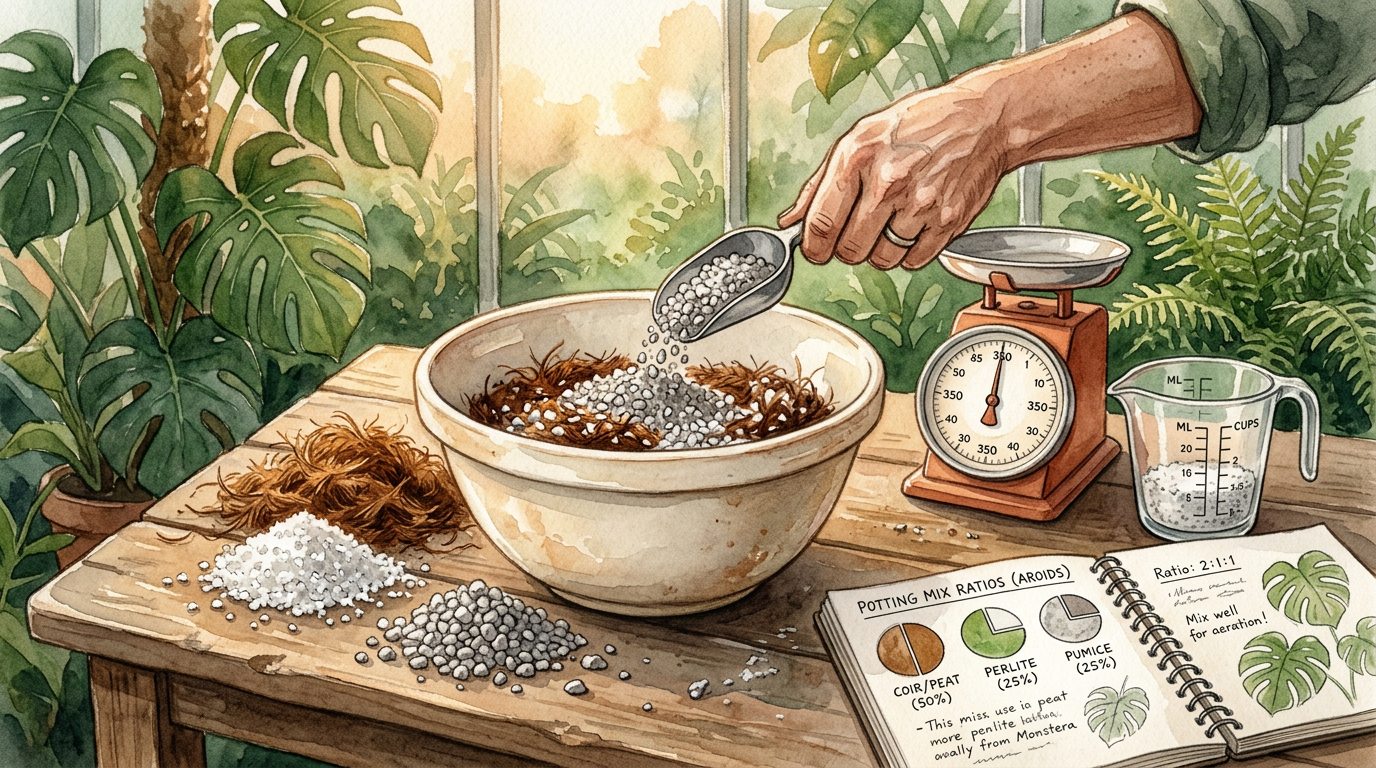
A recipe gets you part of the way there. The thinking behind it is what lets you adapt it. Here’s how we actually design a substrate — working backward from what the plant needs to a ratio that hits it — so you can adjust any mix for your own conditions without guessing.
Quick facts
Topic: How to design a substrate
Level: Applied
Audience: Collectors ready to build or modify mixes
Prerequisites: Articles 1 and 2
Next in series: The Petruscio Substrate System — an overview of our six recipes
We see this pattern whenever collectors use our mixes in their own conditions. Someone in a humid Florida greenhouse mixes our Standard Mineral Mix exactly as published and it works beautifully. The same recipe in a dry Arizona apartment underperforms. The recipe isn’t wrong. The conditions are different, and the ratios were tuned for our environment, not theirs.
So the more useful output is a framework for thinking about mixes, not another recipe. That’s what this article is for.
You’ve got the physics from Article 1 and the ingredients from Article 2. Now we put them together.
Start with the target, not the ingredients
Most hobbyist recipes get made the same way. You pick up a bag of pumice, a bag of coir, and a bag of castings, and you start combining them until it feels chunky enough. That’s why no two hobbyist recipes produce the same results.
Start instead with what you want the substrate to do. Four variables define that target:
Air-filled porosity (AFP) at container capacity. How much air space exists after watering and drainage equilibrium. The number that decides whether roots can breathe.
These ranges are derived from published substrate research on ornamental container production (Chandra et al. 2010 review; PT Horticulture technical guidelines) and validated through Petruscio field testing across hundreds of plants per category (2023–2026):
- Terrestrial tropicals and Marantaceae: 15–20%
- General aroids and hemiepiphytes: 20–25%
- Epiphytic aroids, Anthurium, climbing Philodendron: 25–35%
- Tissue culture Stage 1 (sphagnum only): varies, not a relevant target
Water retention at container capacity. How much water the mix holds in capillary and internal reservoirs. You can measure it informally by pot weight (dry vs. freshly-watered) or formally by volumetric water content.
These ranges reflect published volumetric water-content guidelines for container substrates corroborated by our species-specific moisture-tolerance testing (2023–2026):
- Xeric tropicals (Hoya, Dischidia, Ceropegia): 20–30% of volume
- Standard aroids and tropicals: 30–45%
- Moisture-loving (Marantaceae): 45–55%
Cation exchange capacity (CEC). How well the mix holds onto nutrients between feedings.
- If you fertilize lightly (once a month or less), aim higher. Include zeolite and castings.
- If you fertilize with every watering at low concentration, lower CEC is fine. Fertilizer arrives frequently enough to matter less.
- Practical target: at least one ingredient with meaningful CEC (coir, castings, zeolite) in the mix.
pH. Drives nutrient availability. Most tropical aroids want 5.8 to 6.5. Marantaceae prefer slightly lower (5.5 to 6.2). Mix pH is mostly driven by your inputs. Coir and sphagnum pull it down. Pumice and charcoal push it up. Castings sit near neutral.
Write the target numbers down before you pick ingredients. Every decision that follows should trace back to these four.
The three-layer model in practice
Every well-designed substrate we’ve seen uses variations of the same three functional layers.
Structural minerals, roughly 50 to 80% of the mix. Pumice, perlite, zeolite, horticultural charcoal, lava rock. The skeleton that creates air-filled porosity, doesn’t break down, and defines how long the mix survives before you need to repot.
Water-retentive organics, 15 to 40%. Buffered coir and long-fiber sphagnum. The material that holds water where roots can drink it, provides capillary continuity, and supplies moderate CEC.
Biological / nutrient inputs, 5 to 15%. Earthworm castings, occasionally biochar. The living fraction of the substrate: slow-release nutrients, beneficial microbiota, and humic substances.
A shortcut worth keeping in mind: the three layers correspond to the three questions a substrate has to answer.
- Can air reach the roots? → structural minerals
- Can water reach the roots? → water-retentive organics
- Can nutrients reach the roots? → biological inputs (and zeolite in the mineral layer)
You don’t build a mix by deciding “50% pumice.” You build it by deciding which of those three questions the plant cares most about, setting your layer proportions accordingly, then filling in individual ingredients inside each layer.

The ratio worksheet — our actual design process
This is what we do when we’re designing a new mix or adapting an existing one for unusual conditions.
Step 1. What are you growing, and what does it want?
A Monstera deliciosa and a Goeppertia orbifolia are not the same root-zone problem. Note the plant’s native habitat, its growth habit (epiphyte, hemiepiphyte, terrestrial), and what you’ve observed about its moisture tolerance.
Then write down your four target numbers: AFP, water retention, CEC target, pH target.
Step 2. Set the mineral-to-organic balance
This is the biggest single decision, and it’s largely set by the AFP target. Rough starting ratios:
- 80% mineral / 20% organic — Epiphytic aroids, severe-recovery ICU, very wet environments
- 70% mineral / 30% organic — General aroids, standard tropical collections, average indoor conditions
- 55% mineral / 45% organic — Moisture-loving Marantaceae, mesic Ficus
- 30% mineral / 70% organic — (We don’t go here; this is commercial peat-based territory)
If you’re unsure, err on the mineral-heavy side. It’s easier to water more often than to rescue a plant from chronic over-saturation.
Step 3. Split up the minerals
Distribute your mineral percentage across the structural ingredients. These proportions represent our starting point after testing 30+ mineral-fraction combinations in active growing conditions (Petruscio field work, 2023–2025). They balance aeration (high pumice + perlite share), nutrient retention (zeolite), and structural grip (charcoal). Not the only way to balance those variables — but a tested baseline:
- Pumice: 50–60% of the mineral fraction
- Perlite: 20–30% of the mineral fraction
- Zeolite: 10–15% of the mineral fraction (higher for mixes meant for infrequent fertilization)
- Charcoal: 5–20% of the mineral fraction (higher for epiphytic aroid mixes where aerial roots need chunks to grip)
Pumice is the default backbone because of its combination of aeration, internal porosity, and durability. Perlite adds extra aeration without adding weight. Zeolite adds CEC. Charcoal adds structure and light salt buffering.
Step 4. Split up the organics
Split between buffered coir and long-fiber sphagnum. A useful default:
- Most mixes: 100% buffered coir in the organic fraction
- Marantaceae and moisture-lovers: 70% buffered coir, 30% long-fiber sphagnum
- TC Stage 2 transition: 50% buffered coir, 50% long-fiber sphagnum
- TC Stage 1: 100% long-fiber sphagnum, no other organics, no minerals
Add sphagnum when you want even moisture without going anaerobic, or when antimicrobial properties matter (TC work, cuttings).
Step 5. A little life
Reserve 5 to 15% for castings. Low end (5%) for mixes meant for actively recovering plants (ICU), where microbial food balance is delicate. Middle (10%) for general use. High end (15%) for standard tropicals in well-aerated mixes where you want more passive nutrient availability.
Step 6. Now adjust for where you grow
The starting recipe you just built assumes average conditions. Roughly 50 to 65% relative humidity, daytime temperatures 68 to 75°F, a moderate watering schedule. If your conditions differ, adjust before you mix.
Adjusting for your actual conditions
The published recipe is a starting point, not a destination. Here’s how we think about the main adjustments.
Humidity
In a dry environment, below 45% RH, shift 5 to 10% of the mix from minerals to organics, and add sphagnum to the organic fraction. Your substrate will dry out faster than ours. Hold more water per pot.
In a very humid environment, above 75% RH, do the opposite. Shift 5 to 10% from organics to minerals. Increase pumice and perlite, decrease coir. Your substrate doesn’t need to hold as much water, because evaporation from the pot surface is slow. Air space is more valuable than water.
Temperature
Hot grow area (consistently above 80°F)? Treat it like a dry environment. More water retention needed, because plants transpire more and substrate dries faster.
Cool environment (below 65°F in winter)? Treat it like a humid environment. Less water needed, because transpiration is slow and wet mixes stay wet longer at cooler temperatures, which raises pathogen risk.
Pot material
Terracotta and unglazed clay pots wick moisture through their walls, which means your substrate dries faster than it would in plastic. Add about 5% more organic to compensate.
Glazed ceramic and plastic don’t wick, so a water-retentive mix in a plastic pot dries very slowly. Go about 5% more mineral than your baseline.
Glass or self-watering pots are a different system entirely. Our recipes don’t translate directly. Consider semi-hydro approaches instead.
Pot size and shape
Small pots (under 4 inches) benefit from airier, chunkier mixes. Total substrate volume is low and it wets through fast. Lean mineral-heavy.
Large pots (over 8 inches) create deep saturation zones. Lean mineral-heavy, and also consider bumping up to coarser particle sizes (half-inch pumice, coarser perlite) to reduce the perched water table depth.
Wide and shallow pots have a high surface-to-volume ratio. They dry fast, so slightly more organic is fine.
Tall and narrow pots are the classic aroid shape. Taller pots have deeper saturation zones. Compensate with chunkier particles, not more organic.
Fertilization style
“Weakly, weekly” fertilization (every watering at quarter strength) means low CEC is fine. Reduce zeolite to 5%, castings to 5–8%.
Monthly or less frequent fertilization is the opposite case. High CEC is essential. Keep zeolite at 10% and castings at 10–15%.
If you don’t fertilize at all, mineral-heavy mixes aren’t a good fit. Low-organic mixes will slowly starve plants without supplemental feeding. Either change the mix toward organic-heavy or change the feeding.
A worked example — one recipe, two environments
Let’s take our Standard Mineral Mix and adapt it for two real environments.
Published baseline (Standard Mineral Mix v5):
- Pumice: 35%
- Perlite: 25%
- Buffered coir: 20%
- Earthworm castings: 15%
- Horticultural charcoal: 5%
Target: 20% AFP, 35–40% water retention, pH 6.0–6.5, moderate CEC. Assumes ~60% RH, 70°F growing area, terracotta pot, “weekly weakly” fertilization.
Environment A: Dry Arizona apartment, 35% RH, 75°F, plastic nursery pot, monthly fertilization.
- Dry environment → shift 5–10% from minerals to organics
- Plastic pot → shift 5% from organics to minerals (counterbalance)
- Monthly fertilization → increase CEC; keep zeolite-equivalent
Net adjustment: roughly +5% organic overall, higher CEC.
Adapted recipe:
- Pumice: 30%
- Perlite: 20%
- Buffered coir: 25%
- Long-fiber sphagnum: 5%
- Earthworm castings: 12%
- Zeolite: 5% (new)
- Horticultural charcoal: 3%
Environment B: Humid Florida greenhouse, 80% RH, 78°F, glazed ceramic pot, weekly at 1/4 strength.
- Humid environment → shift 5–10% from organics to minerals
- Glazed pot → shift additional 5% from organics to minerals
- Frequent feeding → low CEC is fine; no zeolite needed
Net adjustment: roughly -10% organic, more structural minerals.
Adapted recipe:
- Pumice: 40%
- Perlite: 25%
- Horticultural charcoal: 10%
- Buffered coir: 15%
- Earthworm castings: 10%
Same plant, same published baseline recipe, meaningfully different finished mixes because the conditions demand it.
When to break from the starting recipe — diagnostic signs
A well-designed mix shouldn’t need constant intervention. But substrate does need to respond to your specific conditions, and sometimes the starting recipe tells you clearly that it needs adjustment.
- Substrate stays wet more than 48 hours after watering: Too organic-heavy for your conditions. Shift to more mineral fraction, possibly coarser grades.
- Substrate dries in under 48 hours in standard conditions: Too mineral-heavy or too coarse. Add organic fraction or shift to finer grades.
- Plant shows calcium or magnesium deficiency (tip burn, interveinal chlorosis on older leaves): Usually a coir problem. Check that your coir is calcium-buffered. If it is, consider adding a dolomite lime top-dress (1 teaspoon per gallon of mix) to raise Ca/Mg availability.
- Plant shows nitrogen deficiency (overall pale yellowing of older leaves): Low CEC. Increase zeolite or castings, or move to more frequent fertilization.
- White salt crust on substrate surface: EC has climbed. Flush thoroughly and reduce fertilizer concentration, not frequency.
- Mix smells sour after 2+ weeks in the pot: Anaerobic conditions. Less organic, more mineral, and/or chunkier particles.
- Roots grow to the pot walls and stop: The mix’s air-filled porosity is adequate at the walls (where the pot material provides aeration) but inadequate in the interior. Either the interior particle size is too fine, or the mix has compacted. Repot and increase coarse mineral percentage.
Common design mistakes
A few patterns we see often, worth calling out:
Over-designing. Ten ingredients at 3 to 10% each. This is a sign of a grower who’s read a lot and wants to include everything useful. It’s not wrong. It’s just not better. At that low an inclusion you usually can’t measure the effect of any single ingredient, and the mix becomes impossible to reproduce consistently. Five to seven ingredients is usually enough. Eight is a lot.
Not adjusting for pot size. Using the same mix in a 2-inch starter pot and an 8-inch finishing pot. Small pots want chunkier, airier mix than the recipe assumes. Large pots want even chunkier. At minimum, shift particle sizes (not percentages) when pot size changes dramatically.
Chasing perfection over consistency. Tweaking ratios based on one or two plants’ responses. Give a new formulation at least two months and multiple plants before you decide. Single data points are noise.
Ignoring the plant in front of you. We’ve seen growers convinced their mix was underperforming when the actual issue was a pest infestation, a light problem, or a fertilizer imbalance. Substrate is one variable. Rule out the others first.
Not writing recipes down. If you’re iterating, you have to record exactly what you mixed each time, or you can’t learn from the results. A small notebook or a spreadsheet column will change how fast you improve.
The short version
Design starts with a target (AFP, water retention, CEC, pH), not with ingredients. The three-layer model (structural minerals, water-retentive organics, biological inputs) answers the three questions a substrate has to answer. You set your mineral-to-organic ratio from the AFP target, fill each layer with a small number of complementary ingredients, and adjust the whole thing for your environment before you mix a single bag.
Humidity and temperature drive organic fraction. Pot material and size drive particle size. Fertilization style drives CEC. Your starting point is a published recipe. Your destination is a recipe tuned for your plants and your growing space.
With this framework, every recipe in the rest of the series (the ICU Mix, the Aroid Mineral Mix, the TC Acclimation Protocol, and the rest) becomes a starting point you can reason about, not a formula to copy verbatim. That’s what makes the difference between a substrate that works on paper and one that works in your specific room.
End of the Foundation Primer
You’ve completed the three-part Foundation Primer. Up next: The Petruscio Substrate System — an overview of our six recipes, followed by a dedicated deep-dive article on each mix. With the physics, the ingredients, and the design framework in hand, the recipes finally make sense.