
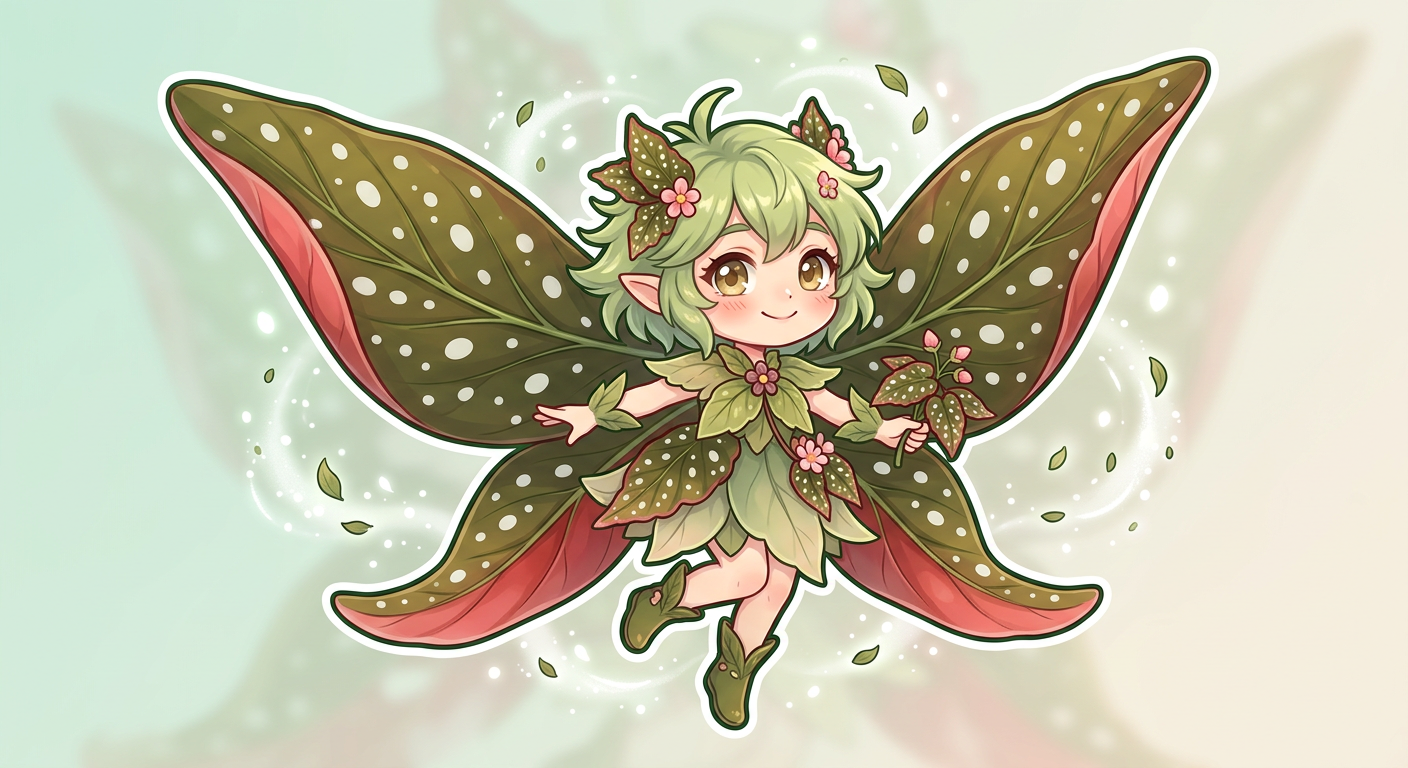
Second in the Petruscio Plant Spirits series — where every care guide arrives with a companion, a character formed from the very plant it represents.
Meet Maculata
Maculata is the showgirl. Olive-green leaves with silver polka dots on top, deep burgundy underneath. She grows fast, flowers easily, and will sprawl into any space you give her.
If Frydek is the moody artist, Maculata is the extrovert at the party. She’s forgiving until she isn’t. Let her sit in wet soil or trap her in dead, humid air, and she’ll punish you fast. Get those two things right, and the rest barely matters.
Here’s what Begonia maculata needs to keep showing off.
The Plant Behind the Spirit
Begonia maculata is a cane-type begonia from the Atlantic coastal rainforest of Brazil. You’ll see it sold as polka-dot begonia or angel wing begonia. Both names land the moment you see a mature leaf: asymmetrical wings, olive-green on top with scattered silver spots, blood-red underneath.
It grows upright on bamboo-like canes. Mature plants reach four to five feet tall indoors if you let them, and they flower a few times a year, small white or pale-pink clusters that don’t last long but signal the plant is happy.
Maculata has an easy reputation. She lives up to it, mostly. She’s forgiving of beginner mistakes, but she hates two things: soggy roots and stagnant humid air. Fix those two, and everything else is just showing up.
Light: Bright, Indirect, and Steady
Give Maculata the brightest indirect light you can without direct afternoon sun. An east window is perfect. South or west works if you set her back a few feet from the glass or filter it with a sheer.
Light keeps the polka dots bright. In low light, the spots fade, leaves go flat green, canes stretch, and the whole plant leans toward the window like she’s trying to escape.
What to watch for: Spots fading and leaves tilting hard toward the light means move her closer. Bleached patches or curled edges on sunny days means pull her back.
Water: Evenly Moist, Never Wet
Water when the top inch of substrate is dry. Begonias have shallow, fine roots that rot fast in cold, soggy soil. They also hate being bone dry. Even moisture, no standing water, and she’ll reward you with new growth all season.
Water at the soil line, never on the leaves. Wet foliage on a begonia invites powdery mildew and leaf-spot fungus. If water lands on the leaves, move her somewhere with airflow until they’re dry.
Use room-temperature water. Filtered or rainwater is ideal. Maculata’s less fussy about chlorine and fluoride than an Alocasia, but she still doesn’t love heavily treated tap water.
Humidity: 50%+, But Move the Air
Maculata wants humidity in the 50-65% range. Higher is fine as long as the air moves. Higher with stagnant air becomes a powdery mildew breeding ground.
This is the single biggest difference between her and most aroids. She doesn’t want a stuffy terrarium. She wants rainforest humidity with rainforest breeze. A clip fan pointed somewhere near her (not blasting the leaves) does more than another humidifier.
Skip the misting. Get a hygrometer and actually measure. If you run below 40% through winter, add a humidifier on a hygrostat and stop worrying about it.
Substrate: Rich, Light, Drains Clean
Begonias aren’t aroids. Don’t pot Maculata in a chunky bark mix. She wants a richer, finer, organic substrate that still drains fast and stays aerated. Here’s the mix that works:
- 50% quality coir-based potting mix
- 20% perlite or pumice
- 15% fine orchid bark or fine fir bark
- 10% worm castings
- 5% horticultural charcoal
Keep her a little root-bound. Begonias flower better in snug pots, and oversized pots hold too much water between waterings. Go up one size only when roots circle the drainage hole.
Temperature & Drafts
Keep her between 65-80°F (18-27°C). She’ll tolerate a night or two in the high 50s but sustained cold below 55°F causes leaf drop. Cold drafts off a winter window brown every leaf they touch.
Heat vents and baseboard heat are worse than cold. They pull humidity out of the room and crisp the leaf margins overnight.
Pinch Her, or She Gets Leggy
This is the step most people skip. Maculata is a cane begonia. Left alone, she dumps everything into one or two tall, floppy stems that eventually snap under their own weight.
Pinch the growing tip off any cane that’s getting too long. The plant branches below the cut, you get a bushier plant, and every cutting is a free propagation. Once a year, cut the oldest cane back hard (down to two or three nodes) and let her rebuild from the base. She’ll come back fuller every time.
Reading Maculata’s Moods
- Yellowing lower leaves, mushy stem base — overwatering. Let her dry out and check the root ball.
- Crispy brown leaf margins — air’s too dry or heat is on her. Move her or add humidity.
- Polka dots fading to plain green — not enough light. Move her closer to the window.
- Tall bare cane with leaves only at the top — she needed pinching months ago. Cut her back hard, she’ll bounce.
- White powdery dust on leaves — powdery mildew. Pull the affected leaves, improve airflow, lower the humidity slightly, spray with a 1:9 milk-to-water solution or a potassium bicarbonate fungicide.
- Clusters of buds that drop before opening — bud blast from a temperature swing or sudden dry air. Stabilize conditions and she’ll try again.
Propagation: Stem Cuttings, Almost Unfair
Take a four- to six-inch cutting from a healthy cane, just below a node. Strip the bottom leaves. Put it in a jar of water or directly into damp, airy substrate. Bright indirect light, 70-75°F. Roots show in two or three weeks.
Every pinch you do for shape is a propagation waiting to happen. This is a plant that wants to be shared.
The Takeaway
Maculata isn’t hard. She’s showy. Bright indirect light, a finer mix than you’d give an aroid, moving air. Pinch her back before leggy. Water when the top inch dries, and never on the leaves.
Do that, and every pinch becomes a new plant. Share the cuttings. That’s half the point of growing her.
Coming next in the Petruscio Plant Spirits series: Meet Kerrii, the patient little heart of Hoya kerrii. Subscribe to follow along.